The Renaissance of Iranian Innovation in the Age of Artificial Intelligence
econews. According to the Iran Economic News Agency, Davood Masoudi, a digital economy expert, in a note sent to Econews, writes:
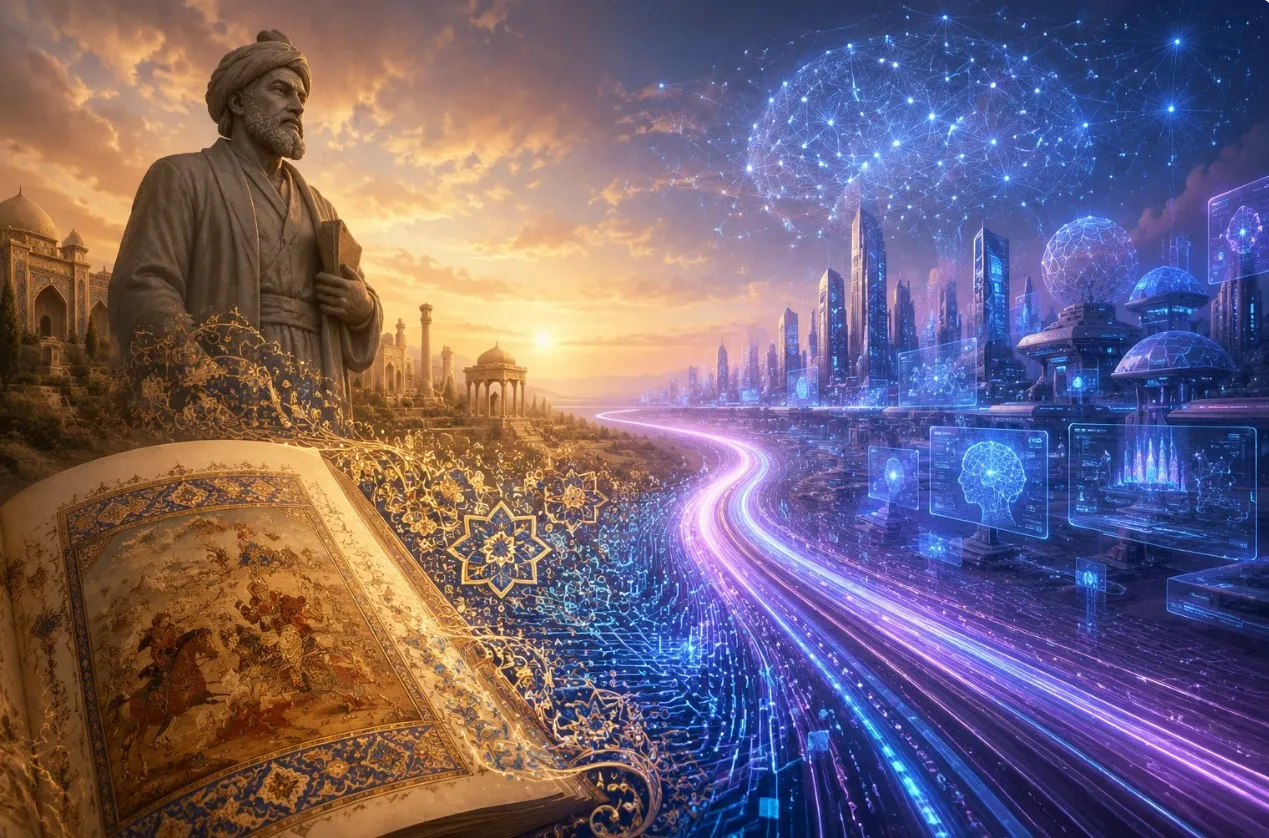
“Today we stand at the threshold of another era—an era equally decisive: the age of artificial intelligence, quantum technologies, biotechnology, robotics, advanced computing, and transformative technologies. If Ferdowsi revived a civilization through words, now is the time to build the future through science and technology.
Iran: A Land of Deep Roots in Knowledge
To chart the future, one must first understand the past with clarity. Iran has been among the pioneers of human history not only in literature but also in science and technology.
Mathematics and Computational Sciences: Muhammad ibn Musa al-Khwarizmi, by founding algebra and introducing the concept of the algorithm, laid the foundations of modern computational sciences; the word “algorithm” itself derives from his name.
Medicine and Life Sciences: Avicenna (Ibn Sina), with his Canon of Medicine, served for centuries as the principal reference for medical education in both the East and the West.
Astronomy and Scientific Engineering: Khwaja Nasir al-Din al-Tusi, through the Maragheh Observatory and his geometric models, left a lasting influence on the development of cosmology.
Experimental Method and Chemistry: Jabir ibn Hayyan was among the pioneers in systematizing experimental science.
Sustainable Engineering and Water Technology: The qanat, a masterpiece of Iranian engineering, exemplifies the profound Iranian understanding of nature, sustainability, and indigenous technology.
Iran has consistently been one of the principal centers of knowledge production in the world. The Academy of Gundishapur, extensive scholarly networks, and the transmission of knowledge from Iran to Europe played a decisive role in the emergence of the Renaissance. Iranian civilization was not merely a consumer of knowledge, but a producer and exporter of it.
However, with the advent of the Industrial Revolution in the West, a historic technological gap emerged. While Europe—and later the United States—advanced rapidly through the Industrial Revolution, steam engines, electricity, electronics, computers, and advanced industries, the Eastern world, including Iran, encountered a technological distance whose effects remain visible today in economic structures, industrial capacity, and national productivity.
The Age of Artificial Intelligence: A Historic Opportunity for Renewal and Leap
Today, however, the era of artificial intelligence, quantum technologies, biotechnology, robotics, and advanced computing presents a historic opportunity before us—perhaps an opportunity that arises only once in the history of any civilization. The nature of these technologies differs fundamentally from the Industrial Revolution, which depended on heavy infrastructure and massive physical capital. In this new age, knowledge, creativity, human capital, learning speed, and the courage to innovate are the decisive assets—precisely the forms of capital in which Iran has historically been rich.
This era offers the possibility to overcome the lag of the industrial age and to return Iran to its natural position as one of the leading civilizations in science and technology. Today, the competitive advantage of nations lies not in underground resources but in capable minds, vibrant innovation ecosystems, investment in deep research, and the capacity to transform science into technology and technology into national wealth.
Yet a warning must be given: if we neglect this decisive moment, the gap that will emerge will not merely repeat the backwardness of the past; it will be several times deeper and far less reparable than the industrial divide. In the age of artificial intelligence, the distance between nations expands at an exponential pace. The future waits for no one.
Returning to a True Position: From Scientific Identity to Technological Power
Becoming a leader in transformative technologies is not a matter of luxury; it is a civilizational necessity. A country that lacks a meaningful presence in artificial intelligence, quantum technologies, robotics, semiconductors, biotechnology, and green technologies will remain dependent not only in its economy but also in security, education, healthcare, and even culture.
To turn this opportunity into reality, it is necessary to:
1. Make strategic investments in deep and fundamental research.
2. Strengthen systematic links among universities, industry, and venture capital.
3. Transform the education system from memorization-based learning toward problem-solving and innovation.
4. Place smart support for startups and leading knowledge-based companies among national priorities.
5. Promote a culture of risk-taking, teamwork, and a global outlook.
This path is not merely an economic trajectory; it is a path of identity. Just as Ferdowsi, through the Shahnameh, preserved the spirit of Iran, today we must revive the power to create the future in Iran through technology.
Today's Shahnameh: National Innovation
Ferdowsi’s Shahnameh told the story of heroes who fought for honor and survival. Our Shahnameh today is written in laboratories, research centers, technology companies, by young scientists and bold entrepreneurs. The heroes of our age are artificial intelligence engineers, quantum researchers, robotics designers, biotechnology specialists, and the architects of the digital economy.
If Ferdowsi rescued the Persian language from oblivion, now it is our time to rescue the future from dependence.
Iran, with its ancient legacy of knowledge and civilization, deserves not to be merely a consumer of technology, but a creator and exporter of transformative technologies. This goal is not mere idealism; with national resolve, scientific planning, and targeted investment, it is attainable.
Now is the time to close the gaps of the past, to compensate for historical backwardness, and to restore Iran to its rightful place among the leading nations in emerging technologies.
Just as Ferdowsi immortalized Iran’s language and culture in his time, it is now our mission to immortalize Iranian innovation and technology in the age of artificial intelligence.
The future will be written—
either by our hands,
or without us.