PSG vs. Arsenal Champions League final 2026: Team news, lineups, and how to watch
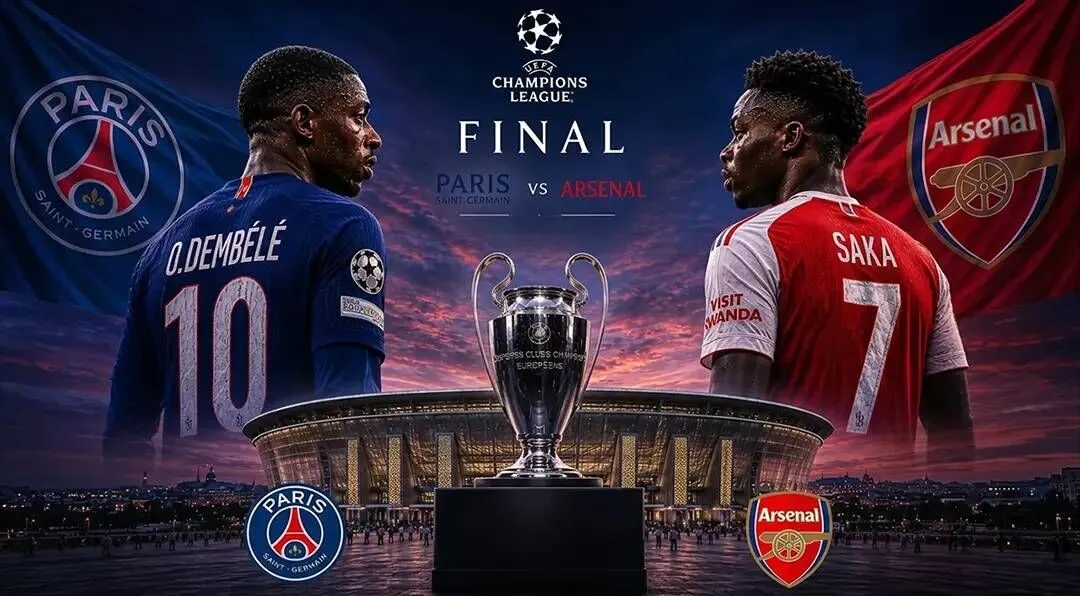
econews. Paris Saint-Germain and Arsenal collide in Budapest on Saturday in one of the most anticipated Champions League finals in recent memory. The holders, who dismantled Inter Milan 5–0 in last year’s showpiece, are chasing history as they bid to become only the second side to retain the European crown since the competition’s 1992 rebrand. Standing in their way are newly crowned Premier League champions Arsenal, who ended a 22-year domestic drought this season and arrive in Hungary hungry for a historic double.
Luis Enrique’s free-flowing Parisians against Mikel Arteta’s battle-hardened Gunners — this one has all the ingredients.
Team News & Injuries
Paris Saint-Germain Injury Updates
PSG’s most significant concern heading into the final is right back Achraf Hakimi, who suffered a hamstring injury during the first leg of their semifinal against Bayern Munich and has not featured since. The Moroccan is trending towards fitness; however, having returned to team training during the week, and is expected to be available for Saturday. Ousmane Dembélé, the reigning Ballon d’Or winner, has also been present in PSG’s latest preparations after recovering from a minor issue and is set to start. Reserve goalkeeper Lucas Chevalier is a doubt with a thigh problem. Fabián Ruiz, who made a timely return from a knee injury and proved decisive in the second leg against Bayern, is fit and poised to start.
- PSG Expected Lineup (4-3-3): Safonov; Hakimi, Marquinhos, Pacho, Mendes; Vitinha, Neves, Fabián; Doué, Dembélé, Kvaratskhelia.
Arsenal Injury Updates
Arsenal’s main selection headache mirrors PSG’s — at right back. Jurriën Timber returned to training this week after two months out through injury, and Arteta confirmed he is fit enough to be named in the starting XI. Ben White remains sidelined with a significant knee issue, making Cristhian Mosquera the alternative should Arteta opt against risking Timber. Noni Madueke’s hamstring problem will not prevent him from being involved, while Mikel Merino made his return to action at Selhurst Park last Sunday following foot surgery in January. The rest of the squad is otherwise healthy.
- Arsenal Expected Lineup (4-2-3-1): Raya; Timber, Saliba, Gabriel, Calafiori; Rice, Lewis-Skelly; Saka, Ødegaard, Trossard; Havertz.
What the Managers Said
Mikel Arteta (Arsenal):
“We won the first one, and tomorrow we want the second. Our preparation has been very good, very focused, and very positive. We have earned the right to be here. Timber and Nwaneri are fit; the only absentee is Ben White. We have analyzed PSG thoroughly, including preparing for penalty shootouts.”
Luis Enrique (PSG):
“Arsenal fully deserved to win the Premier League, and Arteta has built a remarkable team over his seven years there. There is no clear favorite in this final. Both teams want to score and defend well, just through different paths. We are the defending champions, we survived the toughest schedule, and we want to retain our crown.”
Timeline & Recent Form
Last 5 Matches
PSG Recent Form:
PSG head into the final with a mixed run of domestic form — two draws and a surprise defeat to Paris FC — though their Champions League performances have been a different story entirely. The draw with Bayern Munich in the semifinal second leg was enough to see them through, and Enrique’s side have looked composed and controlled throughout the knockout rounds.
- Loss vs. Paris FC (2-1)
- Win vs. Lens (2-0)
- Win vs. Brest (1-0)
- Draw vs. Bayern Munich (1-1)
- Draw vs. Lorient (2-2)
Arsenal Recent Form:
Arsenal arrive in Budapest on the back of five consecutive wins, including a Champions League semifinal victory over Atlético Madrid. The Gunners have been in imperious form, conceding just once across those five matches — a run that underlines the defensive solidity that has defined their title-winning campaign.
- Win vs. Crystal Palace (2-1)
- Win vs. Burnley (1-0)
- Win vs. West Ham (1-0)
- Win vs. Atletico Madrid (1-0)
- Win vs. Fulham (3-0)
Stats (Comparative)
- Wins: PSG 10 | Arsenal 11
- Draws: PSG 4 | Arsenal 3
- Losses: PSG 2 | Arsenal 0
- Average Goals Scored per Game: PSG 2.75 | Arsenal 2.07
- Average Goals Conceded per Game: PSG 1.38 | Arsenal 0.43
- Clean Sheets: PSG 4 | Arsenal 8
Key Stats
- Attacking Threat: PSG’s Khvicha Kvaratskhelia leads his team with 10 goals and 6 assists in the competition. Arsenal’s top scorer is Gabriel Martinelli with 6 goals, while Leandro Trossard tops their assist charts with 4.
- Defensive Solidity: Arsenal boasts a remarkable defensive record this campaign, conceding an average of just 0.43 goals per game and securing 8 clean sheets, compared to PSG’s 1.38 goals conceded and 4 clean sheets.
- Biggest Wins: PSG’s standout victory this season was a 7-2 thrashing of Bayer Leverkusen, whereas Arsenal’s biggest margin was a 4-0 demolition of Atletico Madrid.
Head-to-Head Record
Overall H2H: PSG 2 wins — 2 draws — 1 win Arsenal
PSG have won both of their most recent meetings with Arsenal, including the 3–1 aggregate victory in last season’s semifinal that proved to be a turning point in the Gunners’ evolution.
Match Information & Broadcast
The 2026 Champions League final takes place at the Puskás Arena in Budapest, Hungary. The match will be officiated by German referee Daniel Siebert, with Bastian Dankert serving as the VAR.
How to Watch PSG vs. Arsenal on TV, Live Stream
The match is scheduled for Saturday, May 30, with kick-off at 5 p.m. BST / 12 p.m. ET / 9 a.m. PT. Here is how you can tune in:
- United States: CBS, Paramount+, fuboTV, TUDN USA, DAZN USA, Univision, TUDN , Univision NOW, TUDN App, ViX
- United Kingdom: TNT Sports 1, TNT Sports Ultimate, HBO Max
- Canada: DAZN Canada, fuboTV Canada
- Mexico: TNT Sports, FOX Mexico, Max Mexico, FOX One
Match Analysis Summary
The numbers tell two very different stories heading into Saturday. Arsenal’s defensive record in this Champions League campaign is historically exceptional — 8 clean sheets, conceding just 0.43 goals per game — and it will be tested to its absolute limit by a PSG attack that has averaged 2.75 goals per game in the same competition. Kvaratskhelia, in particular, is the X-factor: the Georgian winger has been involved in 10 goals across the knockout rounds and will likely be the most dangerous player on the pitch. Arteta’s decision over Timber at right back could prove decisive; a fully fit Timber is arguably the best option to contain him, but his two-month absence introduces genuine risk.
For Arsenal, the path to victory runs through their defensive structure and the ability to hurt PSG on the counter. The Gunners have shown throughout this campaign that they can absorb pressure and strike with clinical efficiency — their win over Atlético Madrid being the clearest example. PSG, meanwhile, will look to impose their high-tempo, positional game from the first whistle, with Dembélé, Kvaratskhelia, and Doué capable of unlocking any defence on their day.
Both managers have done their homework on each other, both squads are near full strength, and both clubs are playing for history. It promises to be a final worthy of the occasion.