The EU might weaken its landmark climate law - the ‘most impactful’ in the world

econews. The European Union’s cap-and-trade system has long been considered the gold standard for market-based emissions-reduction policies, and it’s influenced similar efforts from California to South Korea. Since 2005, it’s helped reduce the EU’s industrial carbon emissions by about 50 percent, and a recent working paper called it the “most impactful climate policy in the world.” But a set of changes proposed earlier this month by the European Commission, the bloc’s legislative body, has called its credentials into question.
Wijnand Stoefs, EU policy lead for the European nonprofit Carbon Market Watch, likened the day of the proposals to Black Friday — and he wasn’t talking about the annual shopping event. Instead, he reached for another metaphor. “Smoke appeared from the 13th floor of the Berlaymont,” he wrote on LinkedIn, referring to the Brussels headquarters of the European Commission. “And it was acrid, tarry, black smoke.”
Stoefs’ account is unusually evocative, but he shares concerns with other policy experts who say the commission’s proposed updates — including slower emissions reductions and extra leniency for major polluters — will weaken the EU’s Emissions Trading System, or ETS, while potentially emboldening industry groups that want to weaken cap-and-trade systems elsewhere.
“I think they will have the perfect excuse to go, ‘Hey, the EU isn’t moving ahead as fast as they were,’” Stoefs told Grist. “It’s just, like, a belt of ammunition for industrial lobbyists.”
The ETS is the European Union’s flagship climate policy. It sets a cap on carbon emissions for about 10,000 EU oil refineries, power stations, and other companies that together represent 40 percent of the bloc’s total climate pollution. It works by requiring certain companies to buy “allowances” to cover their expected emissions for the year — and each year, the amount of available allowances shrinks, forcing companies to gradually reduce emissions. Sometimes a polluting company purchases more allowances than they’ll actually need, in which case they can sell their surplus to other firms. Companies that reach the end of the year without enough allowances, however, are subject to heavy fines.
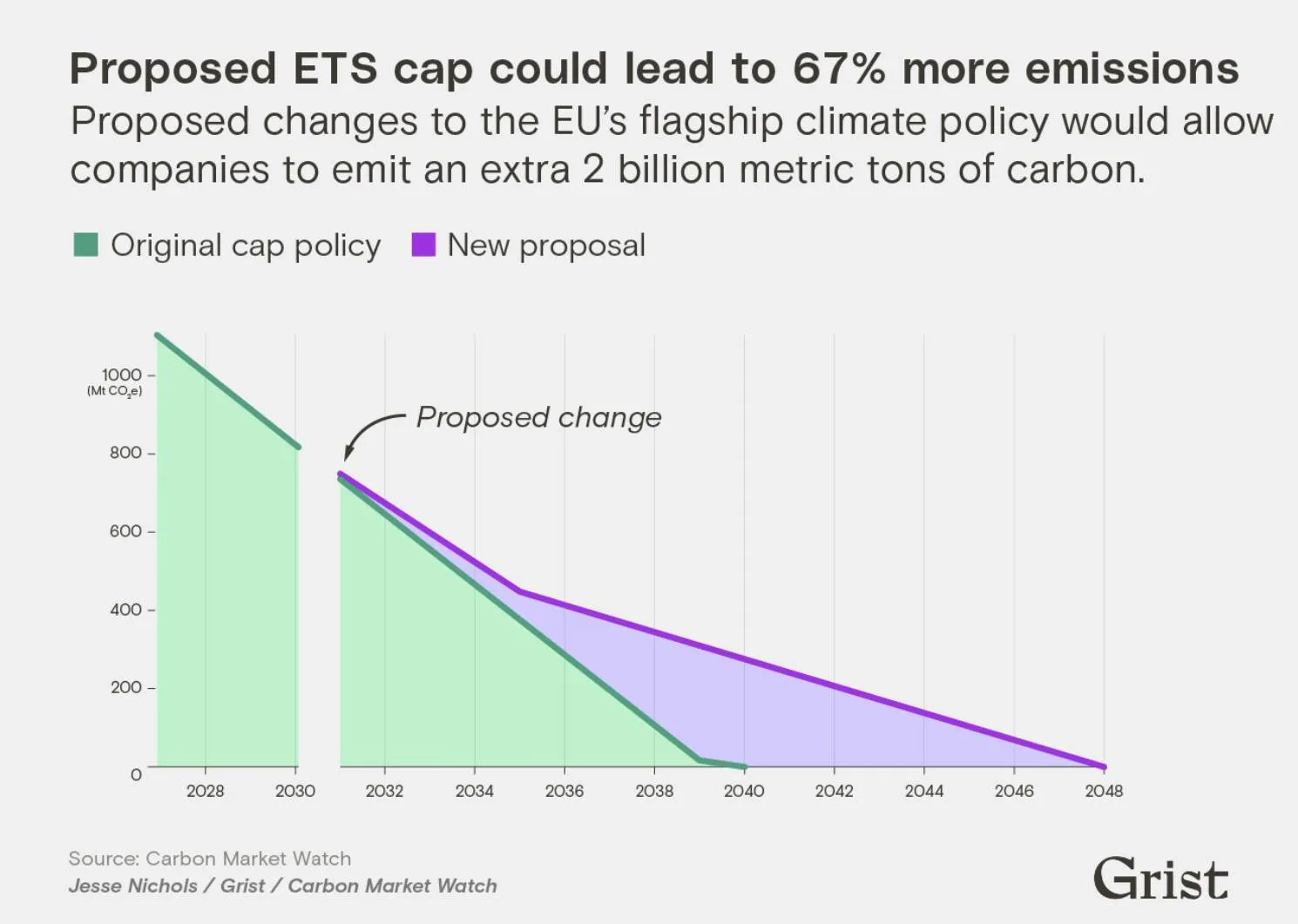
Until earlier this month, the ETS was on track to steer the companies it covers to net-zero by 2039. The most significant update proposed by the European Commission would delay that timeline. Instead of reducing total emissions by 4.4 percent a year until 2039, the commission proposed to lower emissions by 3.7 percent annually between 2031 and 2035, and then just 1.7 percent thereafter.
In explaining the move, the European Commission said it would “bring relief to industry” while still lining up with EU climate law requiring member states to reduce economy-wide emissions by 90 percent below 1990 levels by 2040.
Sven Harmeling, head of climate at the nonprofit Climate Action Network Europe, disputed this claim, saying the bigger issue is all of the extra carbon that may now be released into the atmosphere over the next 14 years. “There are different ways you can get to 2040 with more or less emissions,” he told Grist, and a slower decarbonization timeline has the potential to allow much more pollution than a faster one. Carbon emissions warm up the planet and contribute to more frequent and intense extreme weather, including heat waves, wildfires, and storms.