Europe's established tech firms emerge as unexpected AI winners

The AI boom was widely expected to favour the new companies building the models. Recent earnings suggest it is some of Europe's biggest, well-established technology groups that are emerging as AI beneficiaries.
econews. SAP, Capgemini, Sopra Steria and OVHcloud have all reported stronger demand, faster growth or upgraded outlooks as companies move from experimenting with artificial intelligence to deploying it across their operations.
In the process, they discover that making AI productive inside a complex organisation is proving harder than gaining access to the technology.
Large organisations are unlikely to rely on a single AI provider. Instead, they are expected to use different models for different tasks depending on performance, security and regulatory requirements. The challenge increasingly lies not in choosing a model, but in making AI work with the software, data and business processes companies already use.
"AI applications are the battleground, and that is where most value will be created," UBS said in a recent note.
That plays directly to the strengths of Europe's established software, consulting and infrastructure groups, many of which built their businesses helping large organisations integrate complex technologies long before generative AI emerged.
Most large organisations do not start with a clean technological slate. AI systems must work with software built up over decades, fragmented databases, customised applications and increasingly complex governance requirements. They must also access live company information, while respecting permissions, preserving audit trails and fitting into workflows employees already use.
The complexity of that task is becoming one of the biggest constraints on AI adoption. Boston Consulting Group said deployment was advancing faster than companies' ability to manage it, with more than 70% of investors expressing concern about whether organisations have the technical and operational capabilities needed to succeed with AI.
As companies move from experimentation to application, spending on implementation, integration and governance is becoming an increasingly important part of the AI value chain.
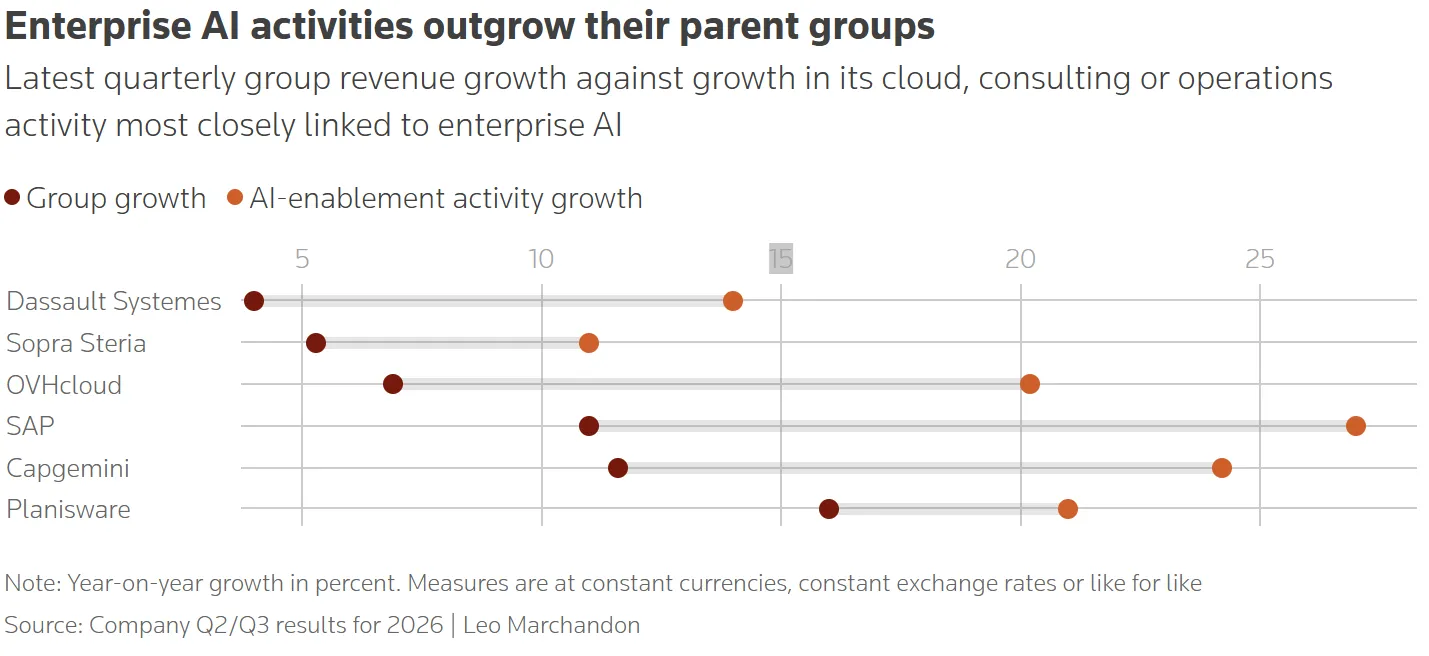
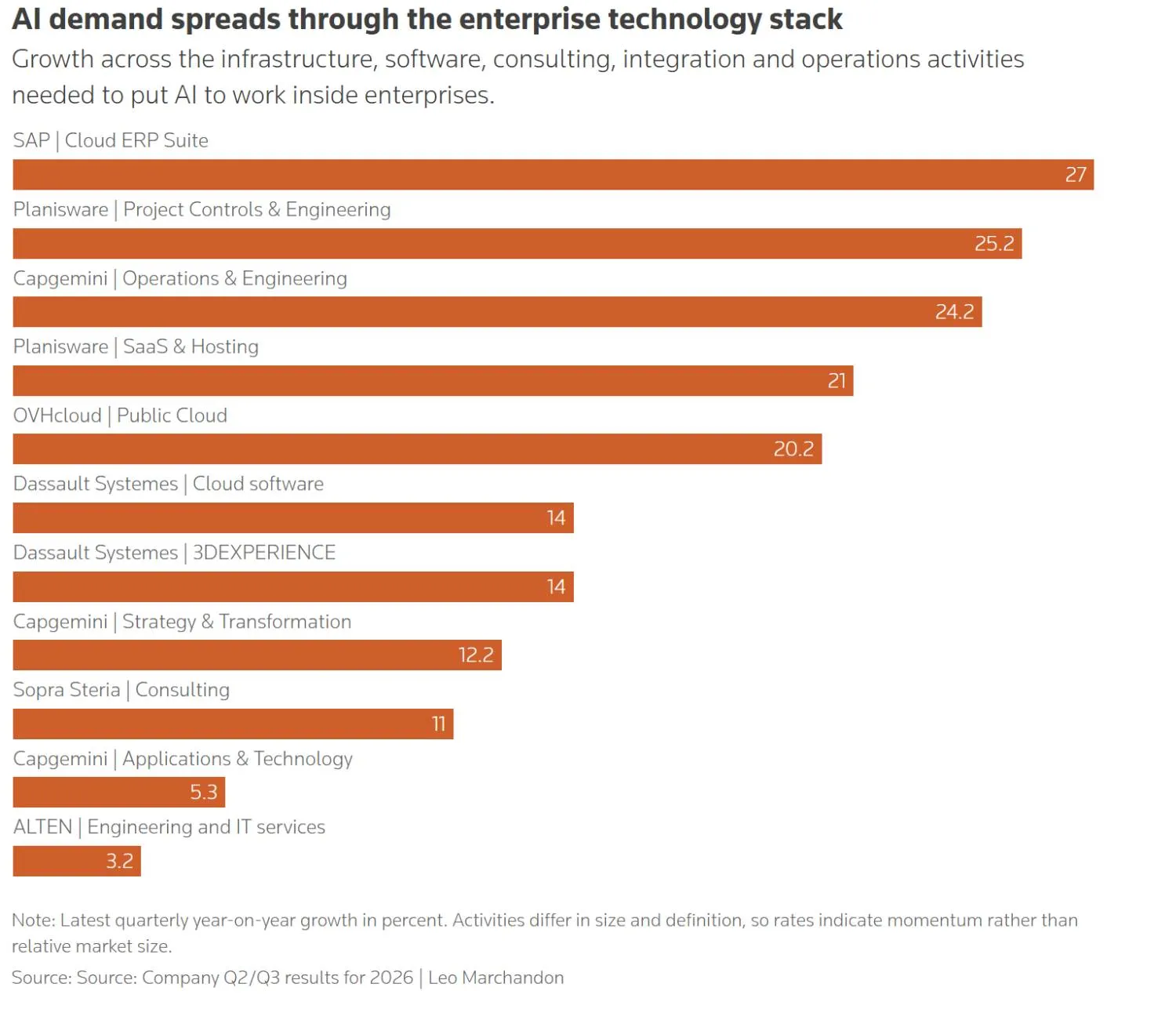
SAP's (SAPG.DE), opens new tab cloud backlog rose 26% at constant currencies to €22.9 billion as companies continued moving critical finance, procurement, supply-chain and human-resources systems onto platforms that increasingly serve as the foundation for AI deployment.
The company's acquisitions of data specialist Dremio and AI company Prior Labs underline the growing importance of making enterprise data accessible to AI applications.
Capgemini (CAPP.PA), opens new tab raised its annual growth target after bookings climbed 9.2%, while Sopra Steria (SOPR.PA), opens new tab upgraded its outlook after organic growth accelerated to 5.3%.
The two Paris-listed companies are benefiting from the work that follows AI adoption: integrating models into workflows, managing data and building governance systems.
That work is particularly valuable in sectors such as defence, aerospace, healthcare and critical infrastructure, where AI must be fitted around specialist software and tightly controlled operational processes.
A second trend is reinforcing the position of Europe's incumbents: growing demand for greater control over AI deployment.
Publicis (PUBP.PA), opens new tab Chief Executive Arthur Sadoun has said clients increasingly want advanced AI models operating within environments where they retain control over their technology and their data.
The preference is strongest in defence, aerospace and critical infrastructure, where concerns over sovereignty, security and compliance are particularly acute.
Airbus' (AIR.PA), opens new tab decision to use Scaleway — owned by French telecoms group Iliad — for sensitive industrial and defence applications, alongside AI tools developed with Mistral, reflects that shift.
Airbus expects around 70 critical applications to run on Scaleway by the end of 2028.
OVHcloud's (OVH.PA), opens new tab public-cloud revenue rose 20.2% in its third quarter, providing early evidence that demand for European-controlled AI infrastructure — not exposed to extraterritorial laws such as the U.S. Cloud Act — is beginning to translate into commercial growth.
Europe's technology incumbents still need to prove that AI-driven demand can be sustained and that margins can withstand the automation of lower-value consulting and software work.
Recent results, however, suggest the biggest beneficiaries of AI may not be limited to those building the models. Increasingly, they may be the companies that make those models usable inside the world's largest organisations.
Reuters reports
Comment