Sisi's 2030 exit plan would keep Egypt in the army's hands
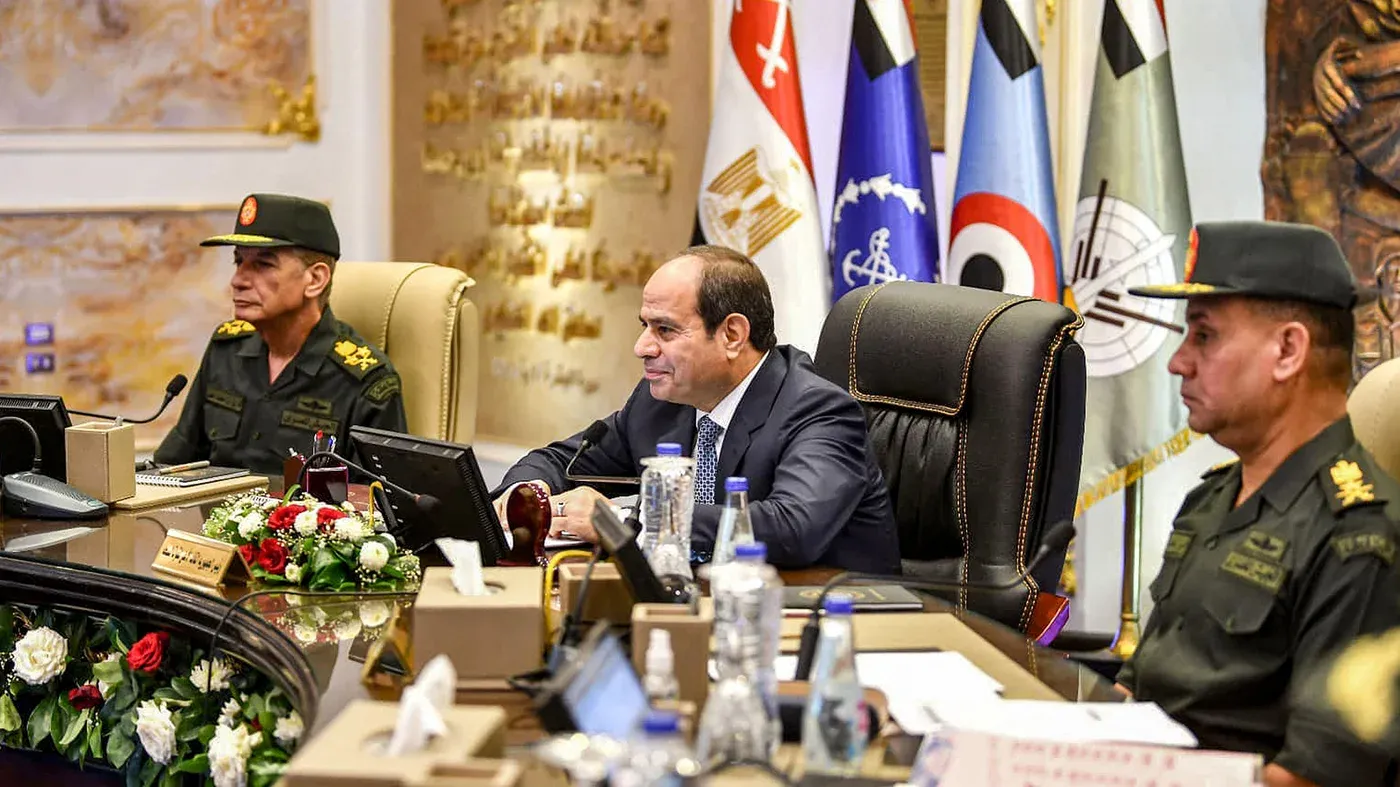
econews. At the Egyptian Military Academy's first graduation ceremony on 17 October, President Abdel Fattah el-Sisi said what many Egyptians had stopped expecting to hear. He declared that 2030 will mark the end of his presidency, "if I live", and that the matter is "completely settled".
Most coverage stopped there, but the consequential part of the speech came next, when Sisi proposed a 30-month programme of more than 7,500 hours at the academy for doctorate holders aged between 40 and 50, from whom Egyptians would later choose their presidents, ministers and governors.
The armed forces would pay "whatever it costs", and a committee including the speaker of parliament and the ministers of higher education and justice would draft a law setting out the selection criteria.
Together, the two halves of the speech describe a president deciding where power will reside after him, rather than returning it to Egyptians. The answer is the military.
Every personalised regime faces the same dilemma, since naming a successor creates a rival while naming no one leaves the elite to fight over the vacuum. Sisi is trying to sidestep both. The 2019 amendments allow him to appoint a vice president, the route Sadat and Mubarak used to reach power, yet he has never used it.
Instead, he is institutionalising the gate rather than the heir, so that whoever governs next would have to pass through an institution owned and financed by the army.
The academy has been moving towards this role for years, running mandatory courses for newly appointed imams, teachers, judges and diplomats. In September, Sisi called it "a gateway to employment in the Egyptian state".
The new proposal climbs the final rung, from training those who are appointed to training those who rule. The defence minister appointed in February, Ashraf Salem Zaher, ran the academy until the day he took office.
The army's veto
The second element, the veto, is already written into the constitution. Sisi read aloud Article 200, which charges the armed forces with safeguarding "the constitution and democracy" and "the civilian nature of the state", saying he had insisted on it in 2014. In fact, that wording came with the 2019 amendments that extended his own rule.
He then promised that no "malicious person, traitor or criminal" would take charge "according to the text I have just read", and added that "what I don't say is more than what I say".
The result is a soft filter that manufactures a preferred elite and a hard veto that lets the army decide who counts as a threat. "We will not prevent anyone," Sisi said, and the door is formally open, but guarded.
None of this requires touching the constitution, because Article 141 leaves "other conditions" for presidential candidates to be defined by law.
Ordinary legislation can require a doctorate, a set age range and an academy certificate, so the promise that the constitution "will not be touched" can be honoured to the letter while the rules of access to power change entirely.
With 30 of the remaining 43 months needed for training, the law must pass in 2027, the very year rumours had assigned to an amendment extending his rule.
The trigger lies inside the regime rather than on the street. In November 2025, parliamentary elections meant to be a formality became an open contest among the state's own agencies.
According to Hossam el-Hamalawy, citing Mada Masr reporting, the interior ministry's security apparatus, which backed the Nation's Future Party, clashed with General Intelligence and Military Intelligence, which backed rival loyalist parties.
Sisi intervened publicly, and the election authority annulled the results in 19 districts, with the courts later voiding many more.
Why now, and what for
On 29 September, in a meeting with the cabinet, governors and the heads of the army and police, Sisi spoke of attempts to set "the interior ministry against the judiciary, the army against someone else, the agencies against each other", and urged officials to stop hiding their opinions.
Two weeks later he declared the constitution untouchable, and three days after that he announced 2030.
The lesson of 2025 is that the unity of Egypt's security apparatus rests on a single arbiter rather than on its structure. Once he announces his departure, every agency starts positioning itself. The academy proposal tries to hand that arbitration to the army before he leaves, though it may provoke the very rivalry it seeks to contain.
Other pressures raised the cost of leaving succession open, including a campaign urging Sisi to rule until 2050 that revived talk of a presidency for life.
The IMF programme ends in December, while Egypt's financing needs are expected to stay high until close to 2030. A Saudi deposit worth more than $5bn fell due in October, and the war in Yemen has flared again, threatening Red Sea shipping.
In the same speech, Sisi pledged to defend Saudi Arabia "in accordance with the directives" of its rulers. For Gulf patrons and creditors, the message was that an army is available now and that Egypt will be predictable after 2030.
The deeper significance lies in what the proposal allows politics to be. For Sisi, the qualification to rule is knowing "what a state means", and no one who merely "says two well-arranged words" should imagine he can lead Egypt. In this view, politics is technical knowledge of the state, which only the state can certify.
The design leaves no role for parties, unions or social movements in producing leaders. In effect, the academy replaces parliament as the school of rulers, and legitimacy shifts from consent to competence certified by an institution issuing a diploma, rather than by voters judging performance.
A doctorate from a "reputable" university and 30 months of full-time training also form a class filter few dissidents, workers or provincial politicians could pass.
More than one way
One proposed exemption deserves particular attention. Sisi would exempt anyone with six years or more in government ministries, saying such experience qualifies them for "the responsibility of a state".
Since the programme cannot produce graduates before 2029, realistic candidates for 2030 are likely to come from this exempt pool of technocrats who owe Sisi their careers. The clause covers ministries but says nothing about the security agencies.
Such a successor would be weak by design, which may suit the military but also leaves room for the outgoing president.
The 2019 amendments bar more than two consecutive terms, not two in total; the transitional article granting Sisi his extra term is open to interpretation by a constitutional court whose president he selects; and if a successor resigns, elections follow within 90 days. None of this proves intent, but the pledge can be fulfilled in more than one way.
Sisi's record counsels caution, since he denied he would run in 2013 and then ran, and backed two four-year terms in 2017 before the 2019 amendments extended his rule. This pledge, though, is more specific than any before it, tied to a date, a committee, a budget and a timetable.
Parliamentary sources close to one of the security agencies told Mada Masr he does not want to repeat Mubarak's mistake of clinging to office. Reversing course would be costly, with a military now given a stake in the rules rather than the man.
The real test comes in 2027, not 2030, and it turns on who sits on the selection committee, whether the programme becomes a condition for candidacy, whether the exemption is widened to the security agencies and whether a vice president is finally appointed.
Egypt's presidents have seldom left office by choice. Sisi may choose to leave, but on terms that entrench, rather than end, the army's political role and replace representation with administration. The question for Egyptians is less whether he leaves in 2030 than whether anything he leaves behind will allow them to choose.
By Hesham Gaafar


- 1 ‘Arab voice doesn’t count’: Jewish Israeli blocs reject Palestinian support
- 2 DC and Virginia sue to block Trump arch construction
- 3 Multiple tankers and drone reported struck around Hormuz
- 4 Patrick Stewart, ‘Star Trek’ Captain Picard and ‘X-Men’ actor, dies at 86
- 5 The US-China trade war seems to have subsided – but the sense of calm is misleading