 Asian stock markets tumble as AI bubble fears deepen
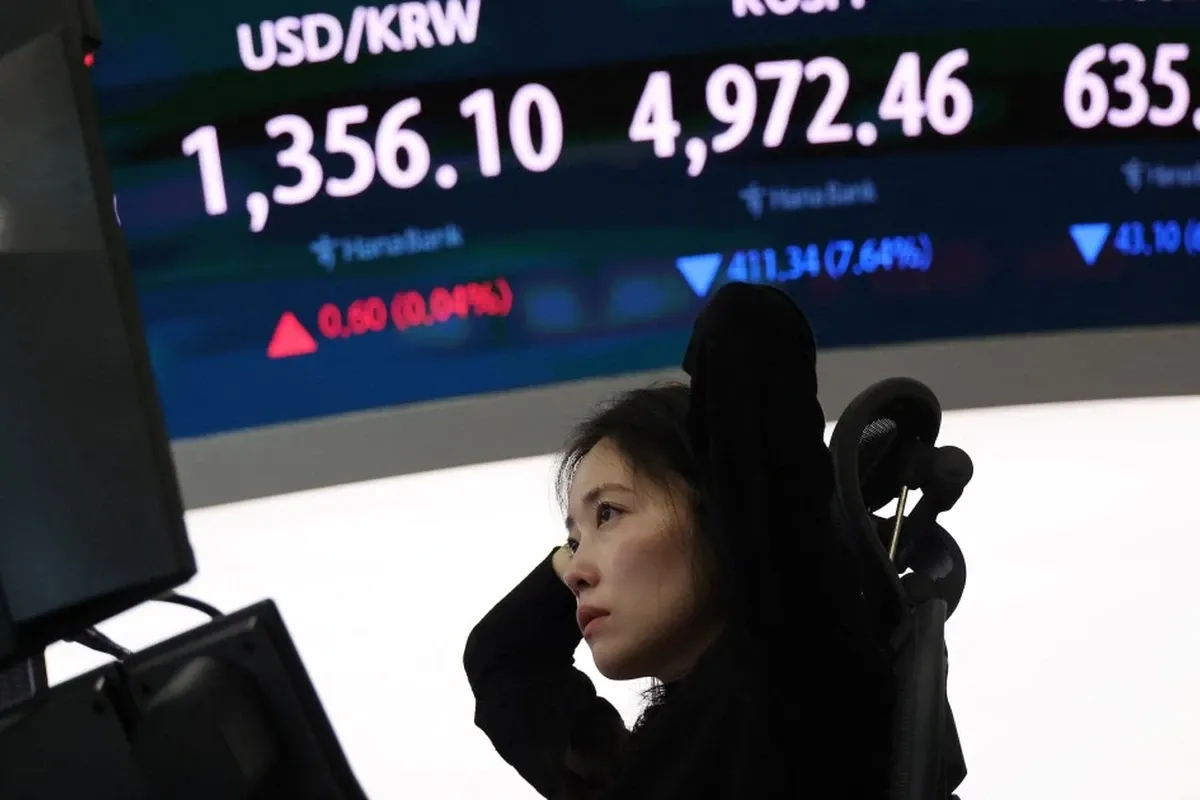
econews . Tech-led selling dragged Seoul, Hong Kong and Shanghai lower after the S&P 500 entered a correction, though US futures pointed to a rebound.
econews. Asian stock markets opened the week to sharp losses on Monday amid dogged concerns over the sustainability of the AI boom, with a tech-led sell-off continuing on both sides of the Pacific.
Markets in South Korea, Hong Kong and mainland China sank deeper into the red. The Korea Composite Stock Price Index (Kospi) in Seoul slid as much as 5.8 percent before paring some losses in the afternoon; the index, which includes memory chip giants Samsung Electronics and SK Hynix, was down 3.2 percent as of 04:30 GMT.
Hong Kong’s Hang Seng Index and the CSI 300 Index in Shanghai were both down about 0.6 percent, after falling nearly 2 percent and 1.3 percent, respectively, in morning trading. Taiwan’s Taiex rebounded from a lower opening to gain 2.5 percent, while Japan’s stock markets were closed for Labour Thanksgiving Day.
On Friday, Wall Street’s benchmark S&P 500 closed 3.7 percent lower to enter a correction — the term investors use when the market drops 10 percent or more from its recent high — while the tech-focused Nasdaq Composite dropped 5.3 percent to erase all of its gains for 2026. The Kospi, Nikkei 225 and Taiex ended the week between 5.1 and 6.2 percent lower, and Hong Kong’s Hang Seng finished down 1.9 percent.
Wall Street appeared on track for a strong rebound on Monday, with S&P 500 and Nasdaq futures up 2.2 percent and 2.9 percent, respectively. “I think markets are trying to find some ground after a massive sell-off in [the] US on Friday, a more than a three-standard-deviation event in tech indices,” Rajat Agarwal, an Asia equity strategist with Societe Generale, told Al Jazeera.
Global AI-related investment is expected to reach $2.7 trillion in 2026 and $3.6 trillion in 2027, according to technology insights company Gartner, and the debt-fuelled investment splurge has stirred debate about whether tech firms are creating a bubble similar to the one that preceded the 2000 dot-com crash. The Democratic Party’s sweeping victory in the US midterm elections is expected to slow data centre construction in US states, while an alleged espionage scandal embroiling chip giant Nvidia and its former CEO Jensen Huang has led to a push for tighter restrictions on China’s access to advanced chips.
“AI-related concerns will continue to dominate this week, as investors try to determine if the bottom is near,” Khoon Goh, head of Asia research at ANZ, told Al Jazeera, adding that South Korea reported very strong exports for the first 20 days of November, driven by semiconductor exports, which were up 294.4 percent year-on-year.
Asian stock markets tumble as AI bubble fears deepen  Anthropic to raise $64bn in major stock market listing
 David Jones’s finances were reviewed and restructuring flagged months before it fell into administration
Comment




Most Read
- 1 EU readies fresh sanctions on Russia amid 'absurd' demands and winter strikes
- 2 Pakistan rejects India's move to hold Indus Waters Treaty in abeyance at UN
- 3 ‘Peace through strength’: Albanese and Trump hail progress on Quad alliance
- 4 EU plans a new €45bn loan to Ukraine. How much will it cost? And will it be repaid?
- 5 Kyrgyzstan sees foreign trade rise to $14.1bln in January-September 2026