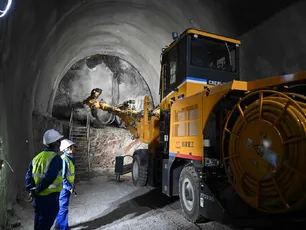
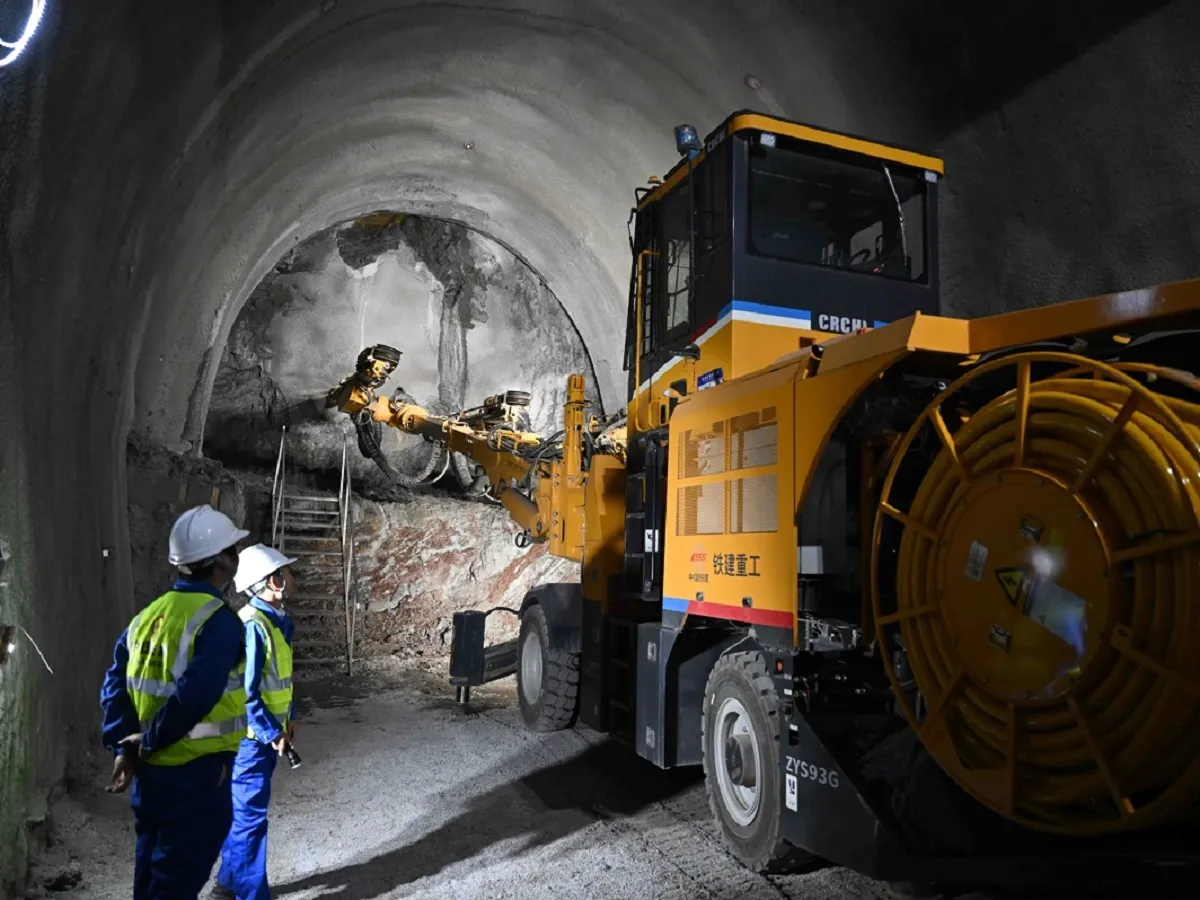
 China-Kyrgyzstan-Uzbekistan railway construction making progress
econews . Beijing recently hosted a signing ceremony for the Central Asia and Caucasus Private Equity Fund.
econews. Construction of the China-Kyrgyzstan-Uzbekistan railway is steadily advancing, with work underway on 28 of the 29 planned tunnels and 47 of 50 bridges along the route’s roughly 305-kilometer Kyrgyz section, according to Kyrgyz Railways, a partner in the project. About 22 percent of total construction work is expected to be completed by the end of 2026, with tunnel excavation currently 21.5 percent complete, earthworks 67 percent complete and bridge pile foundations 95 percent complete, the project’s deputy director general said. The first tunnel, “Kosh-Dobo-2,” was fully excavated in August, and the first bridge structures are expected to be installed in 2027. The railway is officially scheduled to launch operations in 2031, though contractors are striving to finish work earlier. Once complete, the roughly 530-kilometer line will provide China with a shorter, faster, and cheaper rail route into Central Asia and onward markets.
Kyrgyzstan announced that construction is set to begin in Manas on a new airport designed to handle air cargo. With the China-Kyrgyzstan-Uzbekistan railway running through Manas, the new airport facility is envisioned as a key cog in a major air, rail, and road freight network.
Central Asia
Beijing recently hosted a signing ceremony for the Central Asia and Caucasus Private Equity Fund. The Fund is co-sponsored by the China Investment Corporation, Oman’s Investment Authority, the Uzbekistan Fund for Reconstruction and Development, OYAK of Turkey, the Eurasian Development Bank and Shenwan Hongyuan Securities Co., Ltd. The fund aims to invest in companies across Central Asia and the Caucasus, but no information is publicly available about its capitalization, the division of shares, investment start date or the first recipient companies.
The Kyrgyz Marketing Association and the Tajikistan Advertising Association separately signed MoUs with the China Advertising Association, a state-run organization. The deals seek to exchange best practices among Chinese and Central Asian advertisers via the hosting of joint conferences and forums, as well as increase bilateral investment advertising and help Chinese companies enter Central Asian markets.
Kazakhstan
China Energy Engineering Corporation’s international engineering subsidiary has announced the signing of an engineering, procurement and construction contract for a 700 megawatt (MW) solar power project in Kazakhstan’s Almaty Region. The facility will use high-efficiency 720-watt bifacial solar modules and single-axis tracking systems to increase electricity generation. The Chinese contractor’s announcement did not disclose the project owner, contract value, exact signing date, construction schedule or expected commissioning date.
Kazakhstan launched construction of the Iconic Complex in Alatau City, with the state-owned China State Construction Engineering Corporation (CSCEC) serving as general contractor. The mixed-use development, valued at more than $800 million, will include two towers measuring 272 and 78 meters. Completion is scheduled for late 2029. The $800 million represents the total project investment, rather than the disclosed value of CSCEC’s construction contract.
Ride-hailing platform inDrive, Chinese autonomous-driving company Pony.ai and US tech giant NVIDIA signed an MoU to explore deploying autonomous taxis in Kazakhstan. The companies will assess the technical, regulatory and commercial feasibility of introducing Pony.ai’s seventh-generation robotaxis through the inDrive platform, supported by NVIDIA’s autonomous-driving technology. Kazakhstan would serve as a test market, with trials targeted for Astana in the first half of 2027. Commercial deployment remains subject to government approval, and no investment value or fleet size was initially disclosed.
Chinese engineering company Tianchen, a subsidiary of China’s National Chemical Engineering Group, announced that a calcium chloride production unit at a chemical complex in Kazakhstan had successfully completed cold commissioning tests. The milestone represents progress toward operational readiness, but the unit has not begun commercial production.
A Chinese-backed green-energy equipment service center was unveiled during a Kazakhstan-China technical cooperation forum in Astana. Established with the participation of China Service Technology (Shandong) Co. and its Kazakh subsidiary, the initiative will support power-plant equipment maintenance, modernization and specialist training. The center’s operator reported that one steam-turbine modernization project is underway, with equipment deliveries expected in early 2027. Three additional projects remain under discussion.
Kazakhstan’s Ministry of Internal Affairs published a draft law to ratify an agreement with China governing security and law enforcement at the Khorgos International Border Cooperation Center. The agreement, originally signed in Beijing on September 7, establishes procedures for investigating offenses, locating and detaining suspects and responding to national security threats. The draft law’s provisions permit authorities to exchange national security information without a prior request, according to Kazinform. The draft remains open for public consultation until November 18.
Kazakhstan’s PTC Holding signed a strategic cooperation agreement with Chinese railway logistics company International Freight Trains, seeking to expand cross-border railway freight services and attract additional Chinese cargo through Kazakhstan and other Central Asian states. Chinese representatives also expressed interest in PTC Holding’s Silkway CA logistics center under development in Uzbekistan. Details, including investment amount, freight-volume target and implementation timetable, were not immediately disclosed.
Kazakh budget airline FlyArystan launched direct flights between Astana and Yining, in China’s Xinjiang Uyghur Autonomous Region. The route operates three times weekly, expanding the airline’s network to four routes between Kazakhstan and Xinjiang. FlyArystan said it has become the largest foreign airline operating in Xinjiang and plans further expansion.
Uzbekistan
Uzbek car producer ADM Global announced the launch of a $100 million upgrade to its factory in Uzbekistan to assemble new models of hybrid and electric cars of Chinese auto brands Changan, Chery, and Haval.
Uzkimyosanoat, a state-owned company specializing in chemical and fertilizer production, signed an MoU with China Tianchen Engineering Corporation establishing a framework for bilateral cooperation. The agreement covers a joint project to produce ammonia and urea based on deep-coal processing. The parties plan to study the project’s technical and economic feasibility, assess available coal resources, identify optimal technologies and production capacities and consider potential implementation mechanisms.
Energy Minister Sherzod Khodjayev visited a 500 MW wind power plant under construction by China’s Universal Energy in the Samarkand Region. Officials briefed him on the project’s progress and measures being taken to keep it on schedule. The $500 million plant is expected to generate 1.752 billion kWh of electricity annually. The project’s first stage is expected to begin operating by the end of 2026, with full capacity scheduled for 2027.
A delegation from the China Construction Engineering Corporation met with representatives of Uzmetkombinat to discuss building a 60 MW electricity storage system and modernizing the residential facilities for Uzbek workers in the Tashkent region. The Chinese delegation and Uzmetkombinat executives also met with city officials in Bekobod, about 140 kilometers south of Tashkent. There, they signed agreements on joint projects to improve public infrastructure and introduce modern engineering solutions to benefit local residents. Uzmetkombinat is a major producer of metal products in Uzbekistan, including steel.
A delegation from the Ministry of Agriculture and the Lola Murotova AgriculturalCollege attended a forum at Shaanxi A&FTechnology University in Yangling, China. Representatives from Tashkent StateAgrarian University and Andijan Institute of Agriculture and Agrotechnology signed cooperation agreements with ShaanxiA&F University. Higher education institutions overseen by the ministry will launch joint educational programs with the university. The parties also signed agreements providing professional development training in China for professors and teachers.
Kyrgyzstan
Representatives from a Chinese company, Ganfeng Lithium Group, the world’s largest lithium producer that manages the full cycle from lithium extraction to battery production and recycling, met with top officials of Kyrgyzstan’s National Investment Agency to discuss potential investments in the Central Asian state. While no agreements have been signed yet, such a major player’s interest in mining lithium, classified as a highly critical material by the United States and other major global economies, in Kyrgyzstan is notable.
Tajikistan
The National Academy of Sciences of Tajikistan and the Department of Science and Technology of China’s Xinjiang Uyghur Autonomous Region signed an agreement to construct a new laboratory at the Central Asian ResearchCenter for Ecology and Environment in Dushanbe. Also relevant to Chinese-Tajik educational cooperation is an MoU signed between Tajikistan’s Center for International Programs and Beijing Yude International Education Technology Group. The MoU seeks to expand opportunities for Tajiks to study in China for their bachelor’s, master’s, and doctoral programs. The MoU also outlines plans to expand bilateral partnerships between universities.
Turkmenistan
Turkmenistan’s state energy firm signed an MoU with China National Offshore Oil Corporation to expand cooperation in Caspian energy development.
In education-related news, instructors from China’s Xi’an Petroleum University and Hebei Vocational and TechnicalPetroleum Universityheld a weeklong training in Ashgabat for faculty and students of Turkmenistan’s Yagshygeldi Kakayev International University of Oil and Gas. Meanwhile, representatives from Turkmenistan’s Institute of Seismology and Atmospheric Physics learned how to use China’s AI-driven seismic early-warning systems during a visit to the PRC. Also, as part of their visit to China, a delegation from the Myrat Garryyev State Medical University of Turkmenistan met with the leadership of Beijing University of Chinese Medicine and reached agreements on training Turkmen faculty and students and enhancing academic curricula, as well as conducting joint research projects.
China-Kyrgyzstan-Uzbekistan railway construction making progress  Presidents of Uzbekistan and the United States discuss prospects for further strengthening bilateral relations
 Saida Mirziyoyeva meets with the President of France and Minister for Europe and Foreign Affairs
Comment



Most Read
- 1 ‘Arab voice doesn’t count’: Jewish Israeli blocs reject Palestinian support
- 2 DC and Virginia sue to block Trump arch construction
- 3 Multiple tankers and drone reported struck around Hormuz
- 4 France's third weekend of social protests sees lower turnout and early clashes in major cities
- 5 Patrick Stewart, ‘Star Trek’ Captain Picard and ‘X-Men’ actor, dies at 86